
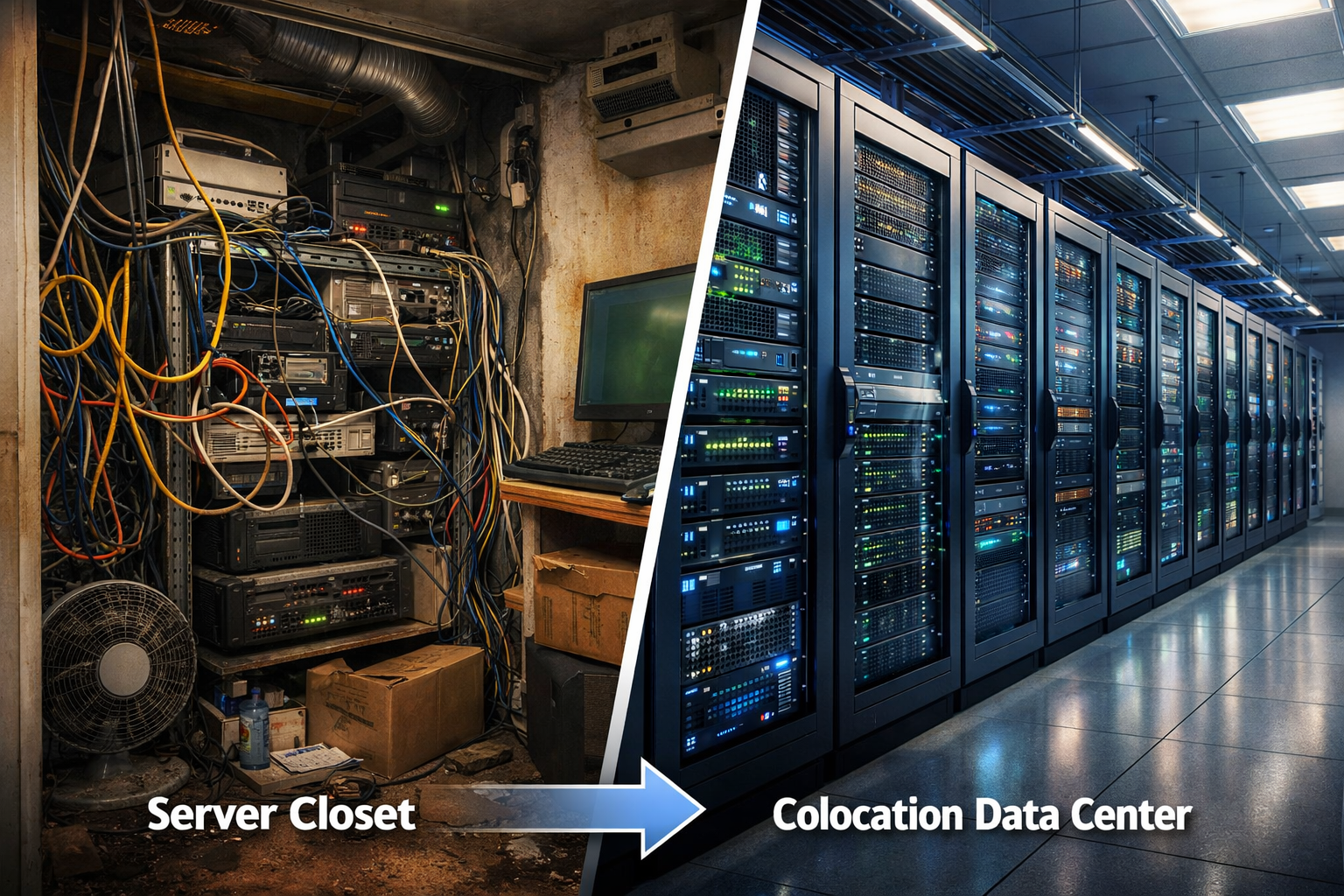
Small and mid‑sized businesses often store their servers in a back‑room closet because it seems convenient and inexpensive. This arrangement may work temporarily, but as your business grows and the demands on your IT infrastructure increase, a makeshift server closet becomes a liability.
A server closet is typically a repurposed broom closet or storage room with no dedicated cooling or security . Officials sometimes remove ceiling tiles to let heat escape and there are usually no cameras or motion sensors protecting the equipment . This lack of environmental control exposes critical hardware to overheating, dust and static charges and leaves it vulnerable to tampering or theft .
Server closets also create operational headaches. Keeping servers safe requires maintaining temperature in the 68–72 °F range and isolating the server room from external heat sources; countless servers have been lost to overheated closets . Without adequate ventilation, the heat generated by servers cannot dissipate, which leads to equipment failure . Humidity imbalances can cause rust, corrosion or electrostatic discharge , while vibrations from nearby hallways can damage spinning drives .
On‑site server rooms are small by design and quickly hit physical space, power and cooling limits . Businesses that build their own rooms maintain full control over their servers, but they also take on the full responsibility of managing and securing the environment; staff must drop other tasks to handle unexpected server‑room issues . Government audits have even called out server closets as security risks and potential access points to broader networks . When hardware ages and patches are missed, unpatched systems become another attack vector .
A data center is more than a server room. It’s a dedicated facility designed to store and manage data efficiently . While a server room might host a few dozen servers, colocation centers can accommodate thousands . They use advanced cooling systems—such as liquid or immersion cooling—that are far more efficient than standard office HVAC and control humidity to prolong hardware life . Colocation facilities provide multi‑layer physical security with perimeters, biometric access and cabinet‑level controls , maintain access logs and monitor everything in the facility .
Scalability is one of the primary reasons businesses move to colocation. On‑premises rooms eventually hit a wall on space, power and cooling , whereas colocation facilities offer virtually limitless capacity so your IT estate can keep growing . This flexibility extends to geography: colocation lets you place servers in locations closer to your customers and switch sites easily, whereas on‑premises infrastructure ties you to a single building .
Data centers are engineered for uptime. They provide redundant power supplies, high‑efficiency cooling and resilience against disasters . In contrast, office server rooms are usually attached to buildings designed for other purposes and cannot match the reliability standards of colocation . Colocation providers also monitor facilities around the clock and often offer “remote hands” to assist with tasks such as replacing hardware or managing network connections.
Operating your own server room is more expensive than many business leaders expect. You must purchase equipment, pay for dedicated power and climate control, and handle security. Over time, these costs often exceed the monthly fee for colocation space. Data‑center operators spread the cost of electricity, cooling and physical security across many customers, which lowers your per‑server costs . Data centers also provide a controlled environment—precisely managed temperature and humidity—that extends hardware life; storing equipment in a non‑conditioned office closet shortens its lifespan .
Colocation is also an investment in people. On‑premises server rooms require IT staff to maintain infrastructure and monitor equipment continuously. In one study, the average IT professional salary exceeded $83,000 per year; that person could be driving innovation instead of babysitting servers . By colocating, you shift many routine tasks—power, cooling, security, maintenance and monitoring—to the provider and free your team to focus on strategic projects.
Modern colocation centers employ robust physical security, including 24×7 on‑site guards, key‑card and biometric scanners and video surveillance . Your on‑site closet might have a lock and a badge reader, but it’s unlikely to meet the same standard . Colocation facilities are also built with compliance in mind; many carry certifications such as HIPAA, PCI‑DSS and FISMA. When auditors assess your environment, they can rely on the data‑center provider’s certifications, saving you time and money .
Colocation isn’t just about renting rack space. Many providers offer managed services such as server setup, performance monitoring, security management and data backup . These services mean you always have expert hands on‑site and don’t need to hire specialized staff. If you need to scale up quickly or recover from an outage, colocation providers can provision additional power and bandwidth faster than you could upgrade an in‑house closet .
Moving out of a server closet can feel daunting, but you don’t have to do it alone. Technic Business Solutions is a managed IT partner with over 50 years of experience supporting businesses’ technology needs . They offer comprehensive managed IT services—including strategy, server, desktop, network, security, backup and cloud support—so you can focus on growing your business instead of worrying about IT issues .
Technic’s cloud backup solutions protect PCs, servers and virtual machines with unlimited backups and rapid recovery, ensuring your data is safe when moving infrastructure . Their partnerships with leading vendors like Dell, HP, Microsoft and Unifi mean you get proven hardware and network solutions tailored to your business . Clients praise Technic for proactive monitoring and quick response times; one testimonial notes that the company monitors their system continuously and resolves issues before they cause interruptions .
When you partner with Technic Business Solutions, their experts can assess your current server environment, design a migration plan, coordinate with a trusted colocation provider and manage ongoing support. Their managed IT services free your internal staff from maintenance tasks, while their backup and disaster‑recovery solutions safeguard your data during and after the transition. With Technic as your guide, you can reap the benefits of colocation—scalability, reliability, security and cost efficiency—without the headaches of doing it yourself.
A server closet might seem like a simple solution, but it exposes your business to overheating, poor ventilation, physical security gaps and compliance risks . Colocation data centers, on the other hand, offer purpose‑built facilities with advanced cooling, redundant power, hardened security, scalable capacity and cost efficiencies . By partnering with an experienced managed IT provider like Technic Business Solutions, you can migrate your servers out of the closet and into a modern data center with confidence and ensure your business has the reliable infrastructure it needs to thrive.